

During active commercial construction, plan on visiting your site weekly plus five to six milestone-triggered visits tied to specific phases. The visits that protect your budget are the ones timed to specific construction milestones. Owners who show up weekly during framing but skip the MEP rough-in and pre-drywall phases are present for the work that's easy to see and absent for the work that's expensive to fix. Your contractors will follow the plans as they’ve been agreed upon, but sometimes an owner may discover that something looks different than expected as plans become reality.
Being on Site at the Right Time Can Save Time and Money
The cost of catching a something you weren’t expecting during framing is a fraction of what it costs after drywall closes the walls. Your visit schedule should be built around that cost gap. The Construction Industry Institute's foundational research on rework has consistently shown that rework accounts for a meaningful percentage of total project costs.
Your contractor may tell you that you don't need to visit often. A good project manager manages the project as communicated on the drawings and advocates for the client, but you are the only person on the project whose financial interest is purely in the outcome and knows exactly what you are expecting of your building.
Your Phase-by-Phase Visit Schedule
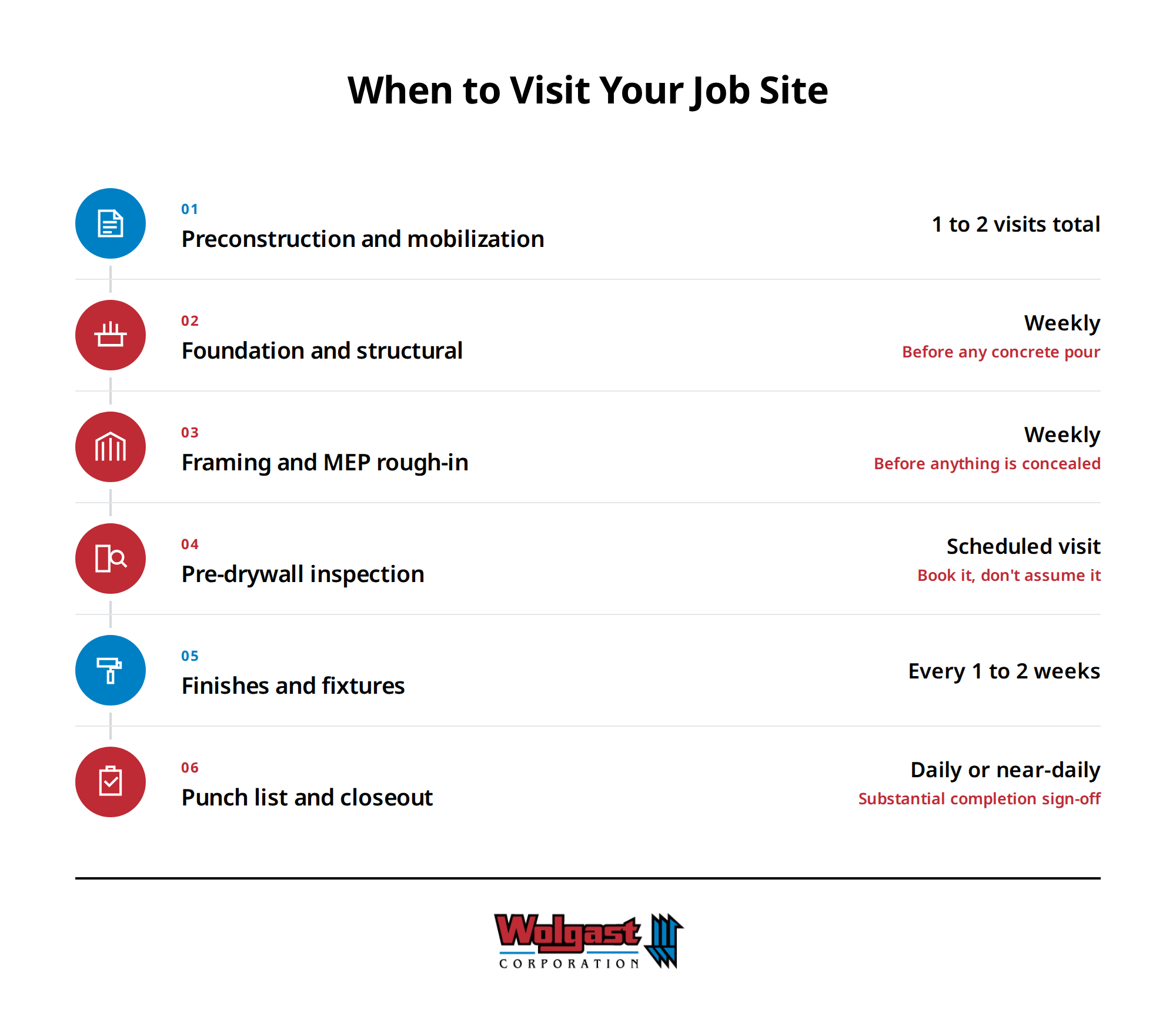
Each phase of commercial construction carries a different risk profile. For best checks that work is done as you expected, your visit cadence should match phase schedules: light during mobilization, weekly during active framing and MEP rough-in, triggered at specific milestone moments, and near-daily during punch list
Preconstruction and Mobilization
Recommended frequency: one to two visits total.
Use these visits to confirm that site access, staging areas, and temporary utilities match what was agreed during preconstruction. Meet the superintendent in person and establish how you'll communicate throughout the project. Walk the site and compare what you see to the plans. Are there surprises about existing conditions that weren't in the drawings?
If your project starts in late fall or early winter, confirm frost protection plans for any concrete work scheduled in the first weeks. Freeze-thaw cycles can create problems early if cold-weather protocols aren't in place.
Foundation and Structural Work
Recommended frequency: weekly, plus one triggered visit before any concrete pour.
The triggered visit matters most here. Arrive before concrete is poured, not after. Once concrete sets, nothing is correctable without significant cost. Look at rebar placement, form alignment, and any deviations from the structural drawings and verify it’s how you communicated it to be.
If temperatures are near freezing, ask the superintendent what cold-weather protection is in place for the pour. The answer to that question tells you whether the team is planning ahead.
Framing and MEP Rough-In
Recommended frequency: weekly.
Mechanical, electrical, and plumbing rough-in is the last time you can see what's inside the walls before drywall closes everything. An owner isn’t expected to inspect the work up until this point, but just view that everything looks in order as expected. Are the rough-in locations matching your approved drawings? Are outlet locations, HVAC drops, and plumbing stubs where you expected them? Finish selections installed in the wrong location are caught here or not at all.
Coordinate visits with your superintendent so you aren't walking through during active trade work. Ask for a 30-minute walkthrough at the end of a shift. The sequencing of trades during this phase affects when specific systems are visible, which is one reason self-performed trades and trade sequencing can make a difference in how smoothly this phase runs.
Pre-Drywall Inspection
This is a triggered visit, not a routine one. Schedule it specifically before drywall goes up.
Look for insulation, blocking for future fixtures, fire blocking, and any MEP rough-in that looks off from the drawings. This visit often aligns with the rough-in inspection by the local building department. Municipal inspection timing varies by jurisdiction, so coordinate with your PM to align your visit with the scheduled inspection.
Photograph everything: walls, ceilings, mechanical chases. This photo record becomes your reference if a question arises after drywall is up.
Finishes and Fixture Installation
Recommended frequency: every one to two weeks.
Are finish selections being installed as specified? Tile patterns, paint colors, flooring materials, and fixture placements are all verifiable now. If something looks different from what you approved, raise it with the PM in writing the same day.
Do not make verbal change requests on-site to subcontractors. Any change request goes through the PM in writing.
Punch List and Closeout
Recommended frequency: daily or near-daily once punch list begins.
Walk the punch list with the superintendent, not independently. Document every item in writing and photograph it. Look for incomplete work, damaged finishes, missing hardware, and items that were on the approved drawings but not installed.
Do not accept substantial completion until you have walked every space yourself. Your PM's punch list and your punch list will not be identical, however your items will likely be on their list also.
If you're planning a commercial construction project and want to understand how Wolgast structures owner communication and milestone check-ins, the preconstruction phase is the right time to get that clarity. Reach out and we can walk you through our process.
What to Do During a Site Visit
A productive owner visit follows a short protocol:
- Talk to the superintendent first, not the subcontractors directly. Going around the superintendent to talk to subs undermines the chain of command and can create confusion about scope and schedule.
- Photograph anything that will be concealed later, anything that looks different from the drawings, and any area where a question might arise.
- Send a brief written summary to your PM after every visit. Even two or three sentences noting what you saw and any questions you have creates a paper trail and signals that you're paying attention.
- Ask the superintendent three questions: What is the schedule for the next two weeks? Are there any RFIs or submittals pending that could affect the schedule? Are there any material deliveries I should know about?
- Do not arrive unannounced without notifying the superintendent. Follow all site safety protocols for visitors, including proper PPE. OSHA 29 CFR 1926 applies to all site visitors, and the superintendent is responsible for enforcing it.
Five Site Visit Mistakes
Expensive owner visit mistakes come from showing up without a protocol, talking to the wrong people, and skipping the phases where problems get buried.
- Arriving unannounced without notifying the superintendent. This disrupts workflow, creates liability exposure, and signals distrust rather than engagement.
- Talking directly to subcontractors instead of the general contractor or PM. Subs take direction from the GC, not the owner. Verbal owner requests create scope confusion and potential change order disputes.
- Visiting only at the beginning and end of the project. The MEP rough-in and pre-drywall phases are where the most expensive problems hide. Consider a building owner who visits during framing and again at punch list but skips the pre-drywall walkthrough. A plumbing rough-in is stubbed in the wrong location for a future restroom. The error surfaces after drywall is up, requiring wall demolition, relocation, patching, and repainting. Experienced superintendents can describe that scenario from memory.
- Making verbal change requests on-site without written follow-up. Verbal changes are not changes until they're in writing, and the cost of undocumented scope changes falls on the owner.
- Not wearing proper PPE or following site safety protocols. OSHA 29 CFR 1926 applies to all site visitors.
How Your Delivery Method Changes Your Visit Cadence
Your project delivery method affects how much time you personally need to spend on-site.
On a Design-Build project, one entity is responsible for design and construction. The owner has a single point of contact for questions, changes, and decisions. This reduces the number of visits needed to resolve coordination issues between the architect and contractor. The Design-Build Institute of America has published research showing that Design-Build projects tend to outperform traditional delivery on schedule and budget metrics, which reflects the reduced coordination burden on the owner.
On a traditional general contracting project, the owner manages a separate relationship with the architect and the general contractor. Misalignments between design intent and field execution are more common and often require the owner to be present to resolve them.
With construction management delivery, the CM acts as the owner's representative. Owners using CM delivery can often rely on the CM for day-to-day site oversight, but milestone visits remain the owner's responsibility.
This isn't a sales pitch for any delivery method. It's a practical observation that the right delivery method for your project affects how much of your own time you'll spend on-site.
If you're heading into a commercial construction project and want to know what level of owner involvement your delivery method requires, that's a conversation worth having before you break ground. Wolgast has managed commercial construction projects across Michigan since 1948 and can walk you through what to expect at each phase.
Frequently Asked Questions
Will Visiting Too Often Slow Down My Crew?
Unannounced, uncoordinated visits can disrupt workflow. Scheduled visits coordinated with the superintendent do not. Frequent visits don't create problems as long as you notify the superintendent in advance and follow the site's protocols when you arrive.
Do I Still Need to Visit If I Hired a Project Manager?
Yes. A PM manages the project on your behalf, but the PM's interest and understanding in completing the work and yours aren't identical. Milestone visits by the owner serve as a check on the process. Most experienced PMs welcome engaged owners who follow the right protocol.
What If I Can't Visit Weekly Because I'm Running My Business?
Weekly visits during active framing and MEP rough-ins are the minimum worth protecting. If your schedule makes that impossible, prioritize the five triggered milestone visits: before concrete pours, before MEP rough-in is concealed, at the pre-drywall inspection, at substantial completion, and at punch list sign-off. Missing those five is where the real risk lives.
Can I Use Site Cameras or Project Management Software Instead of Visiting?
Tools like live site cameras and project management platforms are useful supplements, but they don't replace a physical walkthrough. You can't smell a moisture problem, notice a finish substitution, or have a productive conversation with the superintendent through a camera feed. Use technology to stay informed between visits, not as a substitute for them.
What Should I Do If Something Looks Wrong When I Arrive?
Don't confront the crew directly. Find the superintendent, describe what you observed, and ask for an explanation. Photograph the issue before anything changes. Follow up in writing to your PM the same day with a description and your photos. If the issue isn't resolved to your satisfaction, escalate through your contract's dispute resolution process.
Published September 2026 • Last reviewed September 2026